


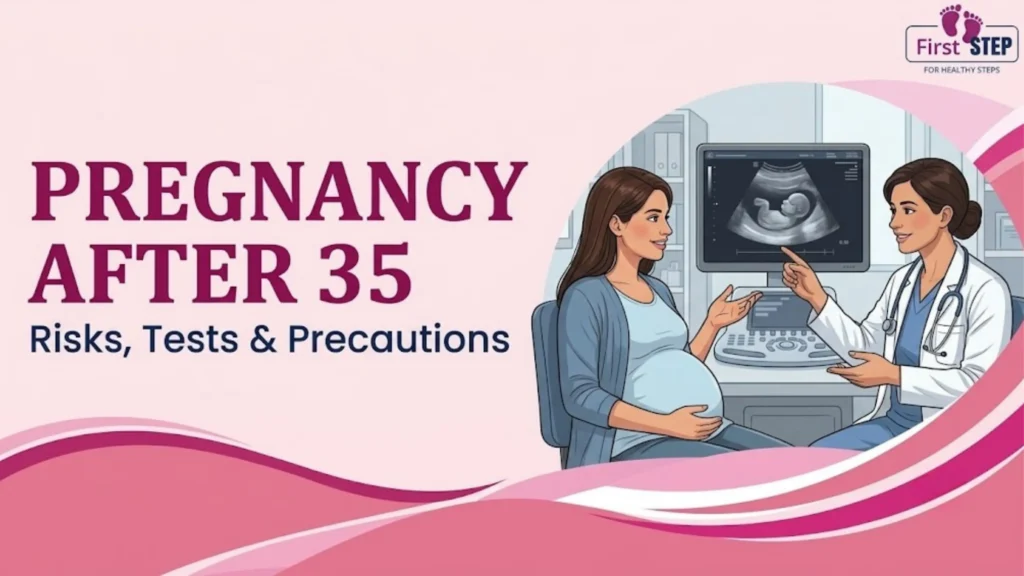
Somewhere between your first antenatal visit and your first scan, someone may have said it: “You’re 35 plus, so this is a high-risk pregnancy.”
If that sentence made your stomach drop, this guide is for you.
Pregnancy after 35 is very common today, and the large majority of women in this age group have healthy pregnancies and healthy babies. But it is also true that some risks rise gradually with age. The aim is not to frighten you. It is to explain what changes, which tests are worth planning, and what you can do to improve your own odds.
Why Is 35 the Number Everyone Quotes?
Doctors use 35 as a practical cut-off for “advanced maternal age” (you may also hear the older, unkind term “elderly primigravida”). It is not a cliff edge. Nothing happens to your body on the morning of your 35th birthday.
Risk rises gradually through the late 30s and early 40s. A woman at 35 and a woman at 34 are not meaningfully different. The number simply marks the point where doctors agree that a little more planning and checking is sensible.
Age is also one factor among many. A healthy 37-year-old with normal blood pressure, normal sugar and a good previous pregnancy history may have a smoother pregnancy than a 28-year-old with uncontrolled diabetes. So think of age as a reason to be a bit more organised, not as a verdict.
What Actually Changes After 35: The Real Risks
1. Chromosomal conditions in the baby
As a woman gets older, the chance that a baby has a chromosomal condition such as Down syndrome goes up gradually. Commonly quoted figures put the chance of Down syndrome at roughly 1 in 350 at age 35 and roughly 1 in 100 at age 40. That means that even at 40, the large majority of babies do not have it.
This is the main reason screening and counselling are offered more actively after 35. It is not that something is expected to be wrong. It is that you deserve accurate information.
2. Miscarriage
The chance of miscarriage in the first trimester rises with age, mainly because chromosomal changes in the egg become more common. Most miscarriages are not caused by anything the mother did or did not do.
3. Gestational diabetes
Sugar problems that first appear in pregnancy become more common with age. Many women have no symptoms, which is why testing is done and not guessed at.
4. High blood pressure and preeclampsia
The chance of high blood pressure in pregnancy, and of preeclampsia (a pregnancy-specific rise in blood pressure that can affect the kidneys, liver and baby’s growth), is higher after 35. Regular blood pressure checks and, in some women, low-dose aspirin started early in pregnancy, can reduce the risk. Whether aspirin is right for you depends on your other risk factors, so it should be a doctor’s decision.
5. Placenta and growth problems
A low-lying placenta (placenta previa) and babies who grow more slowly than expected are somewhat more common. Both are picked up on scans, which is why scan timing matters.
6. Preterm birth and caesarean delivery
Early delivery and caesarean birth are both more common after 35. This does not mean a caesarean is inevitable. Many women in their late 30s and 40s deliver vaginally. It means the delivery plan should be discussed in advance and not decided at the last minute.
7. Twins
The chance of twins is higher with age, and higher again after fertility treatment. A twin pregnancy has its own monitoring needs, which we explain in our guides on twin pregnancy stage by stage and unequal growth in twin pregnancy.
8. Stillbirth
The risk of stillbirth is small in absolute terms, but it is slightly higher after 35. That is a main reason for good growth monitoring, attention to baby movements, and a discussion about the best time for delivery.
The honest summary: every one of these risks is increased, not certain. Most are detectable early, and several are treatable or reducible.
Before You Conceive: Start Here
If you are still planning, a pre-pregnancy visit is the single most useful thing you can do. A good one covers:
- Blood pressure and blood sugar checked and controlled
- Thyroid function, and any other long-term condition reviewed
- Folic acid started before conception, in the dose your doctor advises
- Weight, if it is significantly above or below the healthy range
- Current medicines, to check that nothing needs to be changed before pregnancy
- Vaccinations brought up to date
- Previous pregnancy history reviewed, including any loss or complication
If you have had a previous loss, or have a family history of a genetic condition, ask for this to be discussed before trying, not after the test is positive.
The Tests to Plan, Trimester by Trimester
First trimester (up to 13 weeks)
- Early dating scan: confirms the due date and that the pregnancy is in the uterus
- Blood tests: blood group, haemoglobin, thyroid, sugar and infection screening
- NT scan and combined screening (11 to 14 weeks): the nuchal translucency scan measures a small fluid space behind the baby’s neck, and together with a blood test it gives a risk figure for Down syndrome and some other conditions. This window is short and cannot be repeated later, so book it in advance.
- NIPT (non-invasive prenatal test): a blood test that analyses fragments of the baby’s DNA in your blood. It is a very accurate screening test for the common chromosomal conditions, but it is still screening, not a diagnosis.
The full range of options is explained under pregnancy screening tests, and a detailed first-trimester scan through advanced fetal ultrasound services can look at the baby’s early anatomy and the placenta.
If screening shows a higher chance
A “high-risk” screening result does not mean the baby has a condition. It means the chance is higher than average, and a more definitive test is available if you want one.
Diagnostic options include chorionic villus sampling (CVS), usually done from about 11 to 14 weeks, and amniocentesis, usually from about 15 to 16 weeks. These tests can give a definite answer. The risk of miscarriage from these procedures is small, often quoted as around 0.1 to 0.3% in experienced hands, and is much lower than many people fear. Whether to have one is your decision, and a proper conversation should come before any procedure. The pathway is explained in detail under invasive prenatal diagnostic testing, and prenatal genetics and genetic counselling helps you decide what you would do with the information before you choose the test.
Second trimester (14 to 27 weeks)
- Anomaly scan (18 to 22 weeks): a detailed check of the baby’s heart, brain, spine, kidneys, face and limbs. After 35 it is especially worth doing with an experienced fetal medicine operator.
- Cervical length measurement at the anomaly scan, to assess the chance of early labour
- Blood sugar test (usually 24 to 28 weeks): some women are tested earlier if they have additional risk factors
- Regular blood pressure and urine checks at every visit
Third trimester (28 weeks onward)
- Growth scans to check the baby is growing as expected
- Doppler scans of blood flow, if growth or blood pressure raises a concern
- Fetal movement awareness, learning your baby’s usual pattern and reporting a change the same day
- Delivery planning: timing, route and place, ideally discussed well before the due date
If you have been given a report you do not fully understand, a second opinion fetal ultrasound gives you a clear explanation without disrupting your existing care.
Precautions That Genuinely Help
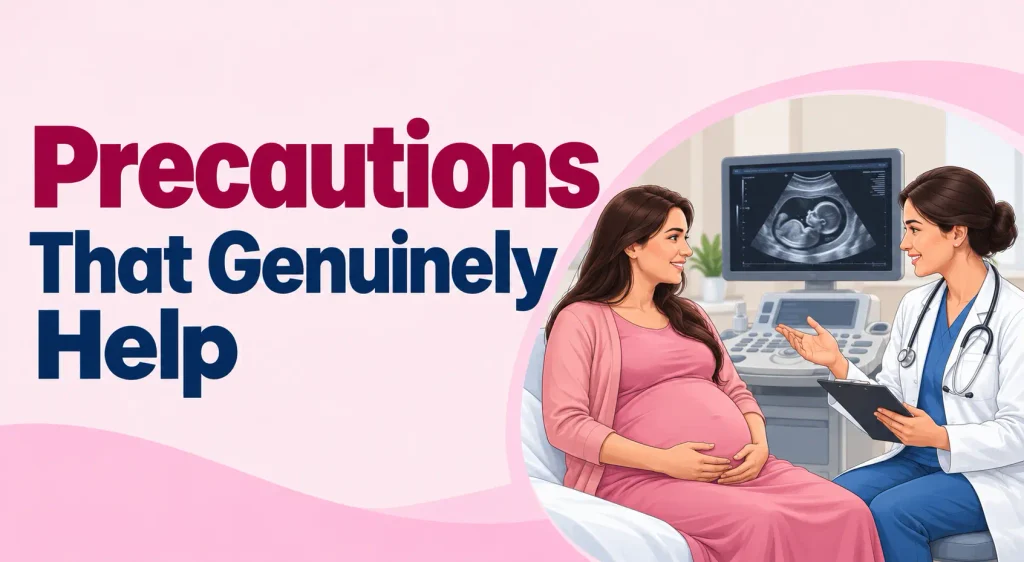
Some advice is generic. These points actually change outcomes.
- Do not skip the time-sensitive scans. The NT scan window and the anomaly scan window both close. A late scan cannot recreate an early one.
- Take folic acid, iron and calcium as prescribed. Anaemia is common and is easily corrected when found.
- Stay active. Daily walking and gentle, doctor-approved exercise reduce the chance of gestational diabetes and help with blood pressure and weight gain.
- Eat regular, balanced meals. You do not need to “eat for two.” Aim for steady energy and plenty of protein, vegetables and fibre.
- Avoid smoking, tobacco, alcohol and unprescribed medicines, including herbal products you have not discussed with your doctor.
- Get the recommended vaccinations in pregnancy, as your doctor advises.
- Monitor your own blood pressure if you are asked to, and keep a written record.
- Learn the warning signs. We list them in our guide to high-risk pregnancy warning signs you should never ignore.
- Do not self-treat. Do not start or stop aspirin, thyroid tablets, blood pressure tablets or insulin without medical advice.
- Look after your sleep and mental health. Anxiety is more common when everyone keeps calling the pregnancy “risky.” Ask questions until you understand your own plan.
Myths About Pregnancy After 35
“I will definitely need a caesarean.” No. Many women over 35 deliver vaginally. A caesarean is more common, not certain.
“Amniocentesis causes miscarriage in many cases.” The risk is small, often quoted at around 0.1 to 0.3% in experienced hands, not the 5 to 10% that some families have heard.
“A normal NT scan means the pregnancy is fully safe.” A normal NT scan lowers the chance of certain conditions. It does not check everything. The anomaly scan, blood pressure checks and sugar test all do different jobs.
“If the screening is high risk, the baby has Down syndrome.” A high-risk screening result is a statistical chance. Most babies from “high-risk” screening results turn out to be fine. A diagnostic test is the only way to know.
“If I feel well, I don’t need all these scans.” Many of the conditions that matter, such as raised blood pressure, high sugar and slow growth, can be silent in the early stages.
When to See a Fetal Medicine Specialist
A specialist opinion is worth taking if:
- You are 35 or above and want a clear, written plan
- Your screening result is high risk or borderline
- You have had a previous loss, preterm birth or severe preeclampsia
- You are expecting twins, or conceived with fertility treatment
- You have diabetes, high blood pressure, thyroid disease or another long-term condition
- A scan has shown a finding you have not been able to get explained
Such pregnancies benefit from structured high risk pregnancy services, where the plan is written down at the start. The specialty behind this work is maternal-fetal medicine, and for routine antenatal care and delivery, the doctor also offers obstetric services in Bhubaneswar.
Pregnancy after 35 is not something to fear. It is something to plan. With the right tests at the right time and a clear plan, most women in their late 30s and 40s have healthy pregnancies and healthy babies. If you want a specialist assessment or a written plan for your pregnancy, you can book a consultation with Dr. Rajeeb Jena in Bhubaneswar.
This article is for general information and does not replace medical advice. If you are pregnant and have any urgent symptoms, go to the nearest hospital.
Frequently Asked Questions
Is 35 really too old to have a baby?
No. Thirty-five is a planning marker, not a limit. Risks rise gradually with age, but most women in their late 30s and early 40s have healthy pregnancies, especially with early planning and regular monitoring.
What tests are recommended in pregnancy after 35?
Early dating scan, blood tests, the NT scan with combined screening or NIPT in the first trimester, a detailed anomaly scan at 18 to 22 weeks, a sugar test, regular blood pressure checks and growth scans in the third trimester. Your doctor may add others based on your health history.
Is NIPT better than the NT scan?
They do different jobs. NIPT is a more accurate screening test for the common chromosomal conditions, while the NT scan also looks at the baby’s early anatomy and other markers. Many women have both. Neither is a diagnosis. Only CVS or amniocentesis can confirm a chromosomal condition.
Is amniocentesis safe?
Done by an experienced operator, the risk of miscarriage from amniocentesis is small, often quoted at around 0.1 to 0.3%. It is a personal decision, and a counselling conversation should always come before the procedure.
Will I need a caesarean after 35?
Not necessarily. Caesarean birth is more common in this age group, but many women deliver vaginally. The decision depends on the baby’s position and growth, your health, and how labour progresses.
How can I reduce my risks in pregnancy after 35?
Start with a pre-pregnancy check, take folic acid, keep blood pressure and sugar controlled, attend the time-sensitive scans, stay active, eat well, avoid smoking and alcohol, and learn the warning signs so you can act early.