


The report says “high risk.” Or “screen positive.” Or “increased nuchal translucency.” Or there is a number you have never seen before, like 1:120, next to a word you did not want to read.
If you are holding that report right now, here is the first thing worth knowing: an abnormal screening result is not a diagnosis. It is a signal that a closer look is worth taking. In many cases, that closer look ends with good news.
This guide explains what an abnormal prenatal screening result actually means, which tests confirm or clear it, and what to do over the next few days.
Screening and Diagnosis Are Two Different Things
This is the single most important idea in this article.
A screening test tells you whether your chance of a condition is higher or lower than average. It does not tell you whether your baby has the condition. Examples: the NT scan, the double marker (combined first-trimester) test, the quadruple test, and NIPT.
A diagnostic test tells you whether the baby has the condition or not. Examples: chorionic villus sampling (CVS) and amniocentesis.
Think of screening as a smoke alarm and diagnosis as the fire brigade checking whether there is a fire. The alarm can go off when there is no fire. That is why a “high risk” screening result is the start of a conversation, not the end of one.
What Does “Abnormal” Actually Mean?
The word covers several very different situations. Check which one you are in.
1. A high-risk combined or double marker result
The test combines your age, the NT scan measurement and blood markers into a single risk figure, such as 1 in 150. Labs use a cut-off to decide what counts as “high risk.” The exact cut-off varies between labs, but a commonly used one is around 1 in 250 to 1 in 300.
What the number means: 1 in 150 means that out of 150 women with the same result, one would be expected to have an affected baby and 149 would not. It is a real increase over average. It is also a 99-plus percent chance that the baby is not affected.
2. An increased nuchal translucency (NT)
The NT scan measures a small fluid space behind the baby’s neck between 11 and 14 weeks. A thicker measurement can be linked to chromosomal conditions, heart problems and some genetic syndromes. But many babies with a raised NT turn out to be completely healthy. What matters is the measurement, the baby’s anatomy on a detailed scan, and any further test results taken together.
3. A high-risk NIPT result
NIPT is a blood test that analyses fragments of the baby’s DNA in your blood. It is a very good screening test for the common chromosomal conditions, but it is still screening. A “high risk” NIPT result needs to be confirmed with a diagnostic test before any major decision is made. This is especially important for the rarer conditions, where a positive NIPT is more likely to be a false alarm.
A “low risk” NIPT is reassuring, but it does not check everything, so the anomaly scan is still needed.
4. A soft marker on the scan
Soft markers are minor findings on an ultrasound that are slightly more common in babies with chromosomal conditions, but are also seen in many healthy babies. Examples include a bright spot in the heart (echogenic intracardiac focus), mildly widened kidney pelvis, a short thigh bone, or a bright bowel.
Important: a single soft marker in an otherwise normal pregnancy, particularly with a low-risk screening result, is very often a normal variation. Its meaning depends on the other results, which is why it should be read by someone who sees these scans every day.
5. A structural finding on the anomaly scan
At 18 to 22 weeks, the detailed scan may show a difference in the baby’s heart, brain, kidneys, face, spine or abdominal wall. This is a different situation from a screening result, because it is something that was seen, not a statistical chance. It needs a specialist assessment, and there is often more to find out about it.
What To Do in the First 48 Hours
Here is a practical order of action.
1. Get the complete report, not just the summary. Ask for the full printout with the measurements, the risk figures, the images, and the lab’s cut-off. A single line of text on a WhatsApp message is not enough.
2. Do not search for the worst-case answer. Search results, forums and video comments show you the extreme outcomes, not the typical ones. They make things feel worse and do not tell you anything about your baby.
3. Book a specialist opinion within days, not weeks. Time matters here, because the options for further testing have windows. A fetal medicine specialist can explain what your result means, review the images, and tell you which next test, if any, is worth doing. A second opinion fetal ultrasound is a good way to do this without disrupting your existing care, and you do not need to leave your own obstetrician to do it.
4. Bring the right things to the appointment. The visit works much better when you bring:
- The original scan images or CD, not just the report
- Your last menstrual period date and any early scan reports
- Details of any previous pregnancy loss or complication
- A list of every medicine you are taking
- Previous blood test and screening results
5. Take your partner or a family member. Two sets of ears take in more than one, especially when you are anxious. If your husband or family member is making decisions with you, this is the appointment to bring them to.
6. Do not make any decision based on the screening result alone. Not about the pregnancy, not about changing hospitals, and not about telling the family. Get the next piece of information first.
Which Tests Come Next?

Your specialist will usually recommend one or more of these, depending on the result.
A detailed (Level 2 or targeted) scan
A scan done by a fetal medicine specialist can look at the baby in far greater detail: the nuchal fold, the nasal bone, the heart, the brain and the face. In many cases, a detailed normal scan significantly lowers the chance of a problem. The detailed assessment offered through advanced fetal ultrasound services is often the most informative first step.
NIPT, if not already done
If your result came from a combined test and no NIPT has been done, it can be offered as a further screen. It is more accurate than the combined test for the common conditions and can reduce the number of women who need an invasive test. It is not a diagnosis, and it is not an alternative to a detailed scan.
Diagnostic testing: CVS or amniocentesis
If the risk is high enough, or a scan has shown a concerning finding, a diagnostic test gives a definite answer about the baby’s chromosomes.
- CVS takes a tiny sample of placental tissue, usually between 11 and 14 weeks
- Amniocentesis takes a small sample of the fluid around the baby, usually from about 15 to 16 weeks onward
The risk of miscarriage from these procedures is small. It is often quoted at around 0.1 to 0.3% in experienced hands, far lower than the 5 to 10% some families have heard. Whether to have a test is your decision, and a proper conversation should always come before it. The process, timing and risks are explained under invasive prenatal diagnostic testing.
The sample can be tested in different ways. A quick test often gives a result for the most common conditions within a few days, and a more detailed test, such as a karyotype or a microarray, may take longer and looks at more. Your specialist will explain which is being used and why.
Fetal echocardiography
If the NT was raised, or the heart looks different, a detailed heart scan (fetal echo) is often recommended, usually from about 18 to 22 weeks.
Infection and other tests
Some findings, such as bright bowel, may prompt blood tests for infection. The reason will be explained at the time.
Genetic counselling
A counselling session helps you decide what testing you want, what each result would and would not tell you, and what you would do with the information. This is best done before any test, not after. Prenatal genetics and genetic counselling is designed for exactly this.
Questions To Ask Your Specialist
Write these down and take them with you.
- What exactly was abnormal, and by how much?
- Is this a screening result or a finding that was actually seen on the scan?
- What is the chance that my baby is affected, in numbers I can understand?
- Which test would give me a definite answer, and by when does it need to be done?
- What are the risks and the cost of that test?
- What would a normal result tell me, and what would it not tell me?
- If a condition is confirmed, what are the options, including treatment during pregnancy where it exists?
- Who will coordinate my care from here?
What If a Problem Is Confirmed?
First, many conditions that are found during pregnancy are far more variable than the first description suggests. A good specialist will explain the specific condition, the range of outcomes, and what is known and unknown, without pushing you in any direction.
Second, a number of structural conditions can be managed or planned for, and in selected situations some can even be treated before birth. A consultation for fetal anomaly and therapy explains what is possible for your baby’s specific finding, and what is not.
Third, the decisions that follow belong to you and your partner. They should be made with full information, enough time, and no pressure. Where decisions need legal or counselling input, a specialist team will explain the framework in India and the relevant time limits. This is one more reason why seeking help early matters.
Complex cases often involve fetal medicine, neonatology, paediatric surgery or cardiology together. Bringing those into one plan is what multidisciplinary fetal care is for.
Common Fears, Honestly Answered
“Did I cause this?” No. Chromosomal conditions and most structural conditions are not caused by anything a mother ate, did, or felt during the pregnancy. Please do not carry the blame.
“Will the needle test cause a miscarriage?” The risk is small and much lower than most families have heard. A specialist will give you the actual figure for your situation before you decide.
“Will I be pressured into a decision?” You should not be. A good consultation gives you information and options, then leaves the choice to you.
“Should I wait and see at the next scan?” Sometimes, a short wait is fine. But some tests have windows that close, so it is worth getting a specialist opinion before deciding to wait.
“Will everything be fine if the follow-up is normal?” A normal diagnostic test or detailed scan is very reassuring for the condition being checked. It does not rule out every possible problem, which is why the routine scans through pregnancy still matter.
Who Is More Likely To Need Extra Support
Screening results are more likely to need follow-up in:
- Women aged 35 and above (see our guide to pregnancy after 35: risks, tests and precautions)
- Pregnancies after a previous affected baby or a family history of a genetic condition
- Pregnancies conceived with fertility treatment
- Twin pregnancies, where screening is more complex
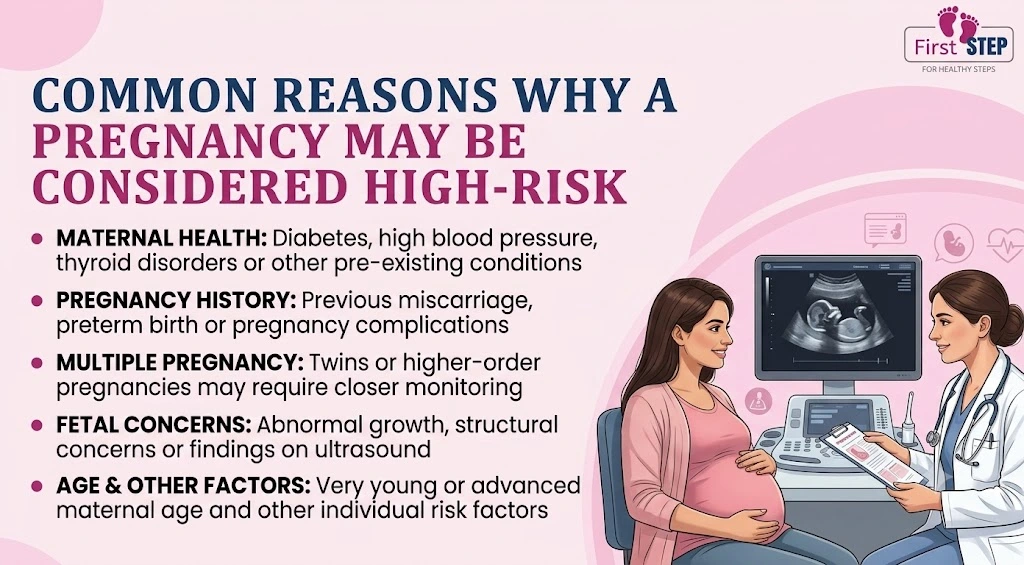
If your pregnancy is also considered higher risk for other reasons, our guide to high-risk pregnancy warning signs lists the symptoms that should never wait.
When To See a Fetal Medicine Specialist
A specialist opinion is worth taking if:
- Any screening result has come back high risk or borderline
- The NT measurement was raised, or a soft marker was reported
- The anomaly scan has shown any structural finding
- You have been told to “wait and see” and want a clearer explanation
- You have a family history of a genetic condition or a previous affected baby
- You want a written plan for the rest of your pregnancy
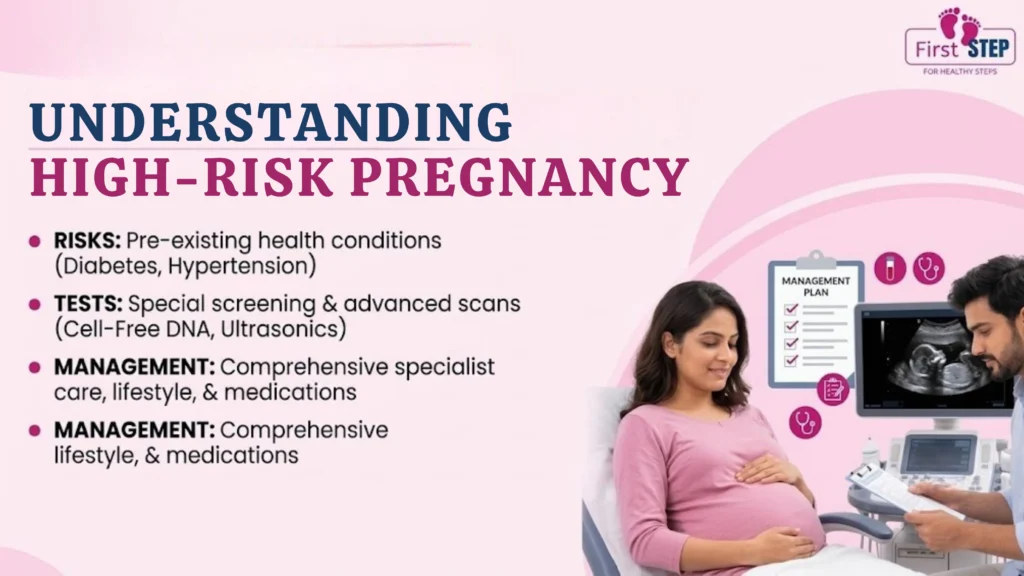
This is the work of maternal-fetal medicine, and where the result also changes how the rest of the pregnancy should be monitored, high risk pregnancy services build that plan.
An abnormal screening result is frightening. But in the large majority of cases, the next step brings reassurance, and in the rest, early information means more options and better preparation. If you have a report in your hand and want a clear explanation and a plan, you can book a consultation with Dr. Rajeeb Jena in Bhubaneswar.
This article is for general information and does not replace medical advice. Please discuss your own report with your doctor.
Frequently Asked Questions
What does a high-risk screening result mean?
It means your chance of a condition is higher than average. It does not mean the baby has the condition. Most women with a high-risk screening result have a baby who is not affected. A diagnostic test or detailed scan is needed to know for sure.
What does a risk of 1 in 150 mean?
It means that among 150 pregnancies with the same result, about one would be affected and the other 149 would not. That is a higher-than-average chance, but a much higher chance that the baby is not affected.
Is NIPT a diagnostic test?
No. NIPT is a very accurate screening test, but it does not confirm a diagnosis. A high-risk NIPT result should be confirmed with CVS or amniocentesis before any major decision is made.
Can a raised NT scan measurement come back normal later?
Yes. In some babies, the raised measurement is a temporary finding and the baby is healthy. A detailed scan, further testing and sometimes a fetal heart scan help decide.
How soon should I see a specialist after an abnormal result?
Ideally within days. Some diagnostic options have a limited window, so an early appointment keeps all your choices open.
Is a soft marker on the scan serious?
A single soft marker in a pregnancy with a low-risk screening result is very often a normal variation. Its significance depends on the other results, so it should be interpreted by an experienced fetal medicine specialist.